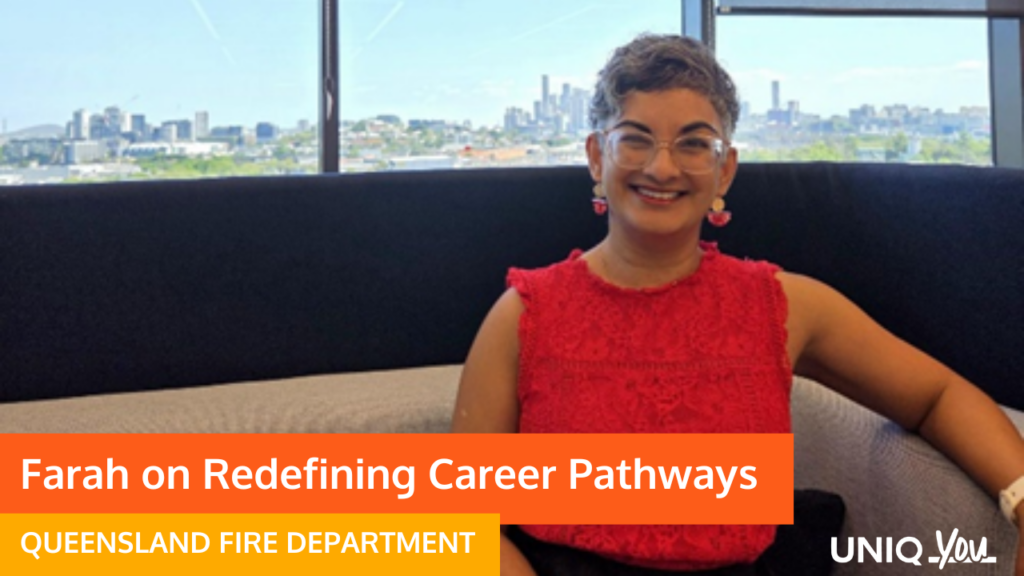
Meet Farah! The Executive Manager – Web, Data and Information management at QFD.
But don’t be fooled by Farah’s formal title, as she manages 5 separate functions, which are: the Information Management Unit, Records Management Unit, Web & Data Services Unit, Power Platform Unit and the Artificial Intelligence Unit.
She’s held various roles since she joined QFD in December 2021:
- Senior Program Officer (Volunteer Capability & Sustainability Unit)
- Principal Advisor Information Management (Information Management Unit)
- Executive Manager (ICT Engagement & Partnerships Unit)
- Executive Manager (Web, Data and Information Management)
She’s also had the privilege of relieving as Director ICT Portfolio Delivery [IT Directorate] and Director Volunteering and Culture [Rural Fire Service Queensland].
In her four years at the Queensland Fire Department, Farah has gained a wealth of experience across a range of diverse roles, building strong insight into career progression and navigating professional transitions.
As she celebrates International Women and Girls in Science Day, Farah shares her practical career tips, reflections on her journey, and advice for women considering a future in science.
What specific application tips do you share with candidates moving from different industries?
There are several non-technical skills that are transferable regardless of industry. They often, far outweigh technical or subject matter expertise. For example:
- Communication skills
- Strategic thinking
- Problem solving
- Stakeholder engagement and relationship building
- Learning mindset and a willingness to work as a team
These (and more) are the fundamental tools that everybody can build and strengthen. Then the ‘growth and opportunity’ lies in which industry you want to apply your skills.
These skills make you a global candidate.
Certainly, these have supported my 20yr plus career where I have never held the same role or job title twice!
How do you ensure your recruitment process supports career changers fairly?
I try to look for the ‘wildcard’. Somebody who may not necessarily neatly fit the role description. They are often the career changers. If they have the core skills and the right attitude, they can always be supported to learn the industry-specifics.
My preference is to hire for attitude because industry-specific skills can be taught to the right person.
What makes your organisation attractive to people wanting to break into your industry?
We have an amazingly complex ecosystem when it comes to work. Not only firefighters, but we have scientists, educators, technologists, the whole gamut of corporate services (policy, strategy, finance, procurement etc.) and volunteering. You can work in the regional areas or metropolitan and no two days are the same when it comes to what we do.
The opportunities to work either in the frontline or corporate side brings so many options to find out what will make you jump out of bed in the morning!
What advice would you give to a woman considering a move into a science-adjacent role but unsure if she ‘fits’?
Science provides a fantastic base from which to launch into almost any career. The training and mental models focus on curiosity, ability to be comfortable with the unknown, experimentation and testing hypotheses and adjusting based on feedback and evidence.
The right ‘fit’ is how you see the world, regardless of the context.
Can you find something interesting in any sector? Do you want to understand it more deeply? Great, then you are the right fit. If you have a science background, your skills are absolutely transferable so jump in and experience a new adventure!
What do you wish more girls knew about careers in science and science-related fields?
Science has a root in ‘knowledge’. If you are curious about the world in which you live, there is an amazing breadth of topics from which to choose a career. You can explore the natural world (physical, earth and life sciences), social sciences and ‘formal’ sciences (technology, engineering etc.).
A career in science is more than the stereotypical images of people in thick glasses and lab coats. You can really make an impact through whatever interests and skills you have. There are jobs that get you out and about into the field, research roles, technology roles and even science communication.
Remember, that for as long as you are fascinated and want to know and understand what things are and how they work, you are already a scientist!